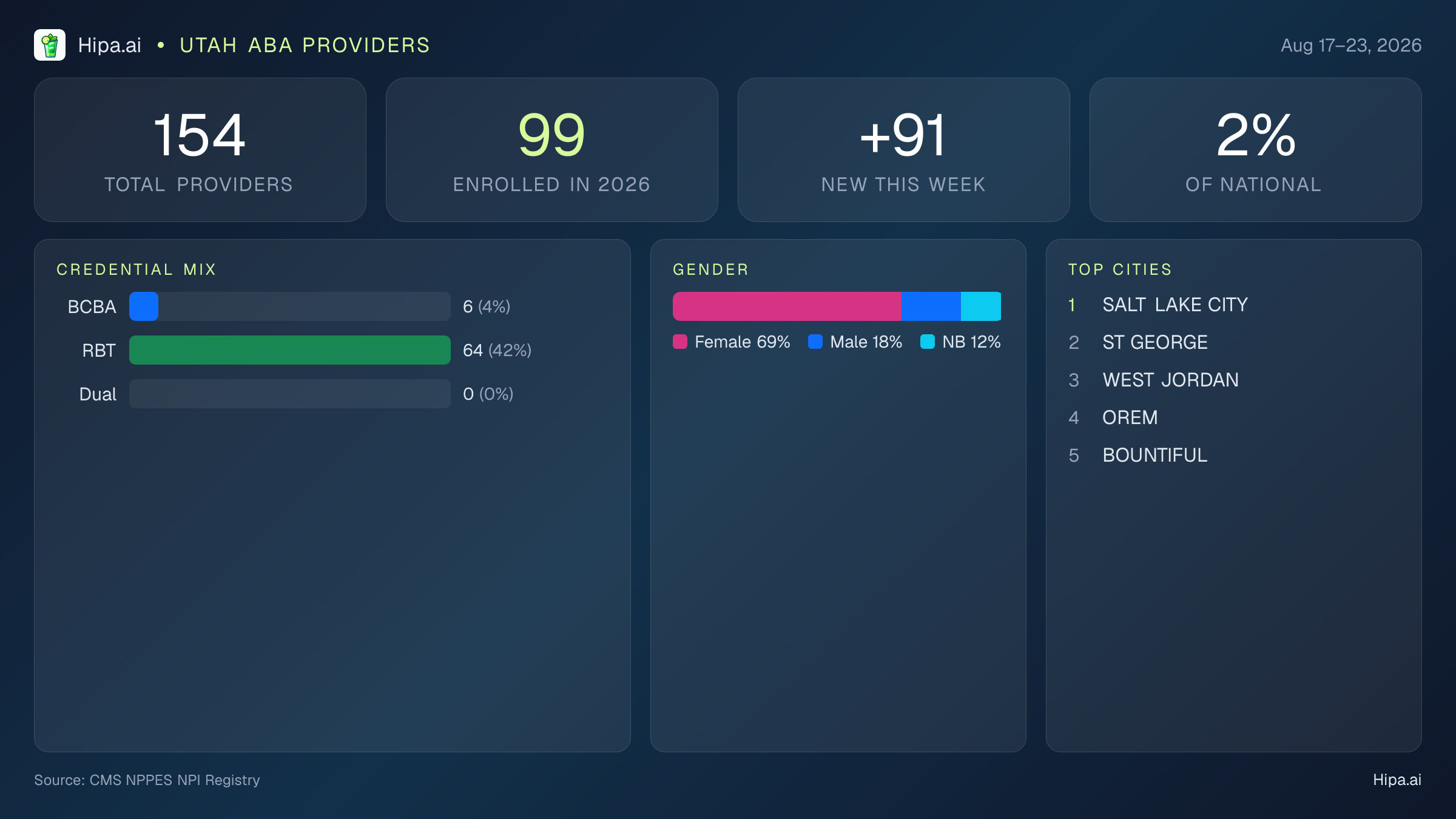
Utah recorded 154 providers in the latest CMS NPI registry weekly update, representing 2% of the national weekly total. The registry added 91 new providers this week, bringing the year-to-date count to 99. Individuals account for 137 entries and organizations for 17. That concentration signals a meaningful, fast-moving behavioral health market, although NPI activity does not confirm that a provider is actively accepting patients, affiliated with a specific clinic or immediately available for care.
ABA Workforce Mix
The registry lists 6 BCBA credentials and 64 RBT credentials, with no dual BCBA-RBT credentials recorded. These credential counts can overlap with other credentials and taxonomy fields, so they are not mutually exclusive shares of Utah’s provider total. The roughly ten-to-one difference between RBT and BCBA counts points to a workforce weighted toward direct service rather than clinical supervision. Because BCBAs supervise RBTs, conduct assessments and oversee treatment quality, a small supervisory pool can constrain how quickly new RBT capacity translates into expanded ABA access.
Demographics and Provider Activity
Among individual providers, the gender breakdown is 95 female, 25 male and 17 nonbinary providers, or 69%, 18% and 12%, respectively. The registry’s leading cities are Salt Lake City, St. George, West Jordan, Orem and Bountiful, showing activity across both the Wasatch Front and southern Utah. No organization is identified as appearing multiple times in the notable-organizations field. Fourteen providers have multiple taxonomies, another reason registry categories should be read as overlapping signals rather than a single workforce census.
Utah’s surge in RBT registrations suggests growing potential for ABA service delivery, while the limited BCBA count leaves supervisory capacity as the key workforce constraint.